
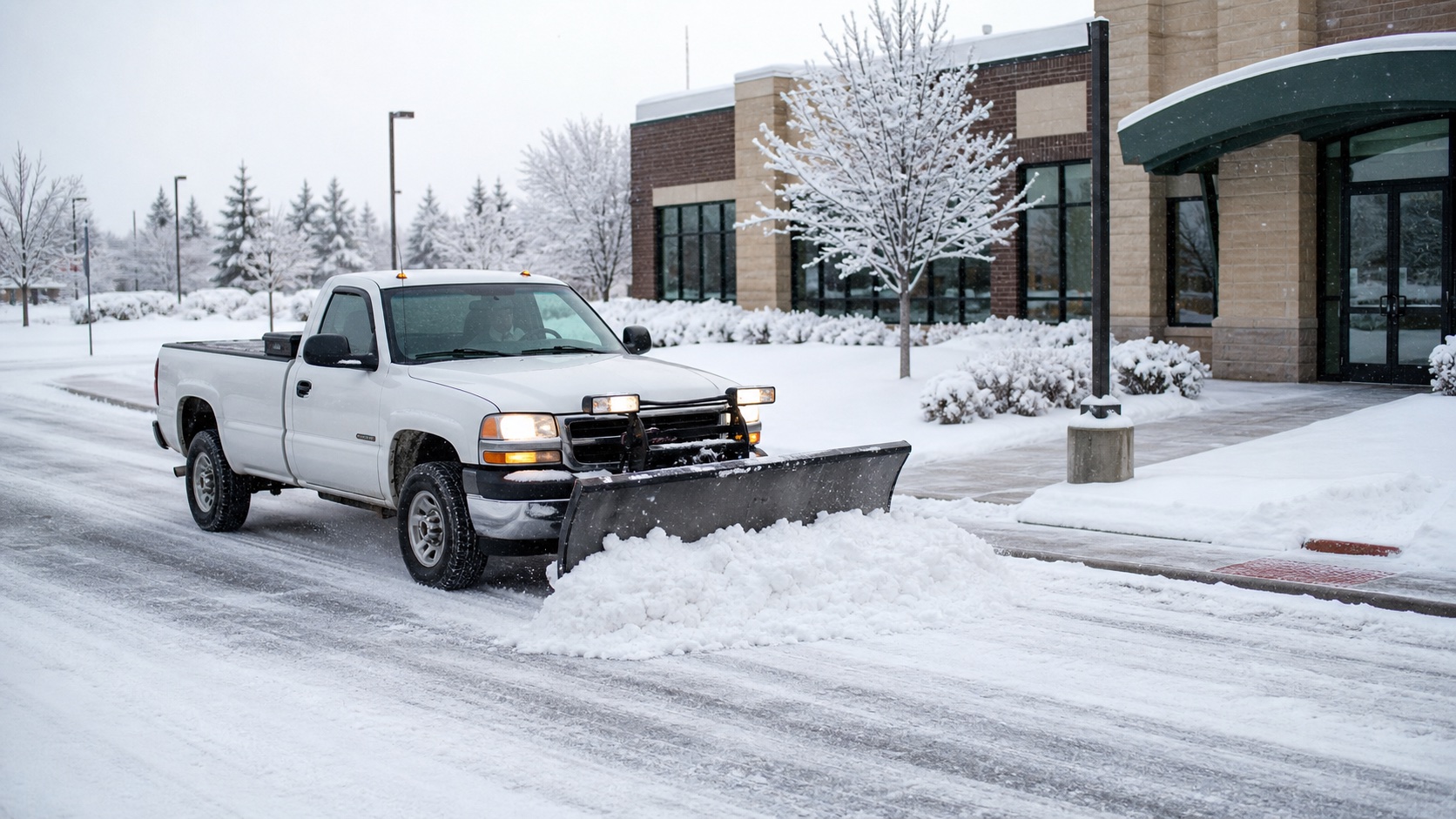
The short answer: a snow gate can reduce what a street plow leaves at a driveway, but it is not a guarantee
After a city street is plowed, a ridge of snow can remain across a driveway entrance. That ridge is often called a windrow. The City of Bismarck says it uses snow gates on eight-foot driveways to reduce the amount of snow deposited by snow plows into driveways; the snow is placed at the side of the driveway instead.
That is useful driveway-access information, but a snow gate is not an All Clean Solutions service, an installation promise, or a guarantee that a driveway will stay clear in every storm. Accumulation, drifting, repeated city passes, parked vehicles, traffic, surface conditions, visibility, and the approved private-property scope can all change what still needs attention.
Separate the city street pass from private-property snow service
City crews manage public streets according to their own routes and priorities. A private driveway, parking lot, entrance, walk, or customer approach is a different surface with a different scope. A street plow can change the driveway entrance after private-property work has already been completed.
For Bismarck, Mandan, Lincoln, and nearby North Dakota properties, the practical first step is to identify where public street operations end and the private access route begins. A snow-removal estimate should name the driveway, entrance, drive lane, sidewalk, or parking area that is included. It should also explain how a later windrow, fresh drifting, or city-plow pass will be reported and reviewed rather than silently assuming every later change is part of a routine visit.
Check whether the driveway is a candidate for a snow gate
The City describes snow gates as a measure used for eight-foot driveways. It also says the property owner remains responsible for making sure sightlines do not create a safety risk. That means a property should not treat a gate as permission to ignore visibility at the driveway, corner, sidewalk, mailbox, or pedestrian route.
If a driveway repeatedly develops a difficult ridge, start by documenting the actual entrance: the driveway width, curb line, nearby street, mailbox or cluster box, fire hydrant, parked vehicles, sidewalk, drainage, and the place snow would be directed. Ask the City directly about its current snow-gate practices and eligibility instead of assuming a private contractor can add or control one.
Plan the private driveway side of the problem
A private snow plan can still account for the portion of the property that the customer needs kept usable. For a home, that may be the driveway and one walking route. For an apartment, office, shop, church, or rental, it may be a private drive, customer entrance, employee route, parking access, or delivery approach.
Before winter, clarify:
- Which private areas are included in the snow-removal scope
- Whether the driveway entrance or a later windrow is included, excluded, or reviewed case by case
- Where snow may be stacked without reducing visibility, access, drainage, or usable parking
- Which vehicles, trailers, gates, or containers can block equipment access
- Who should report a changed condition and who can approve added work
- Whether salt, sand, hand detail, a return pass, restacking, or hauling needs a separate discussion
The goal is not to promise bare pavement or an unchanged driveway after every public plow pass. It is to give the property and service team a clear way to recognize the actual access issue and compare it with the approved scope.
Do not push private snow into the street
The City of Bismarck's snow-removal guidance says it is illegal to shovel or blow snow into the street. The City also says contractors, businesses, and residents should not push snow into the street or across it onto the boulevard when clearing lots or driveways.
That rule matters when a driveway windrow feels frustrating. Moving the ridge back into a traffic lane can create another hazard and is not a substitute for a property-specific snow plan. If stacking space is tight, review the available private areas, sightlines, drainage, future accumulation, and whether restacking or quoted hauling needs to be considered.
Report the exact change after a street-plow pass
When driveway access changes after a storm, a useful update gives more than a general request to “clear the entrance.” Share the property address, the exact driveway or approach, when the ridge appeared, whether a city-plow pass occurred after the last private-service visit, and wide photos that show the driveway, street edge, and nearby obstacles.
That detail can help separate a new windrow from drifting, packed snow, refreeze, a vehicle-blocked route, or a snow pile that has narrowed access. It also prevents a property from assuming that a later pass, different equipment method, or added work is automatically included before the current condition and agreement are reviewed.
Keep driveway access and winter safety in the same plan
The City asks drivers to use caution around snow-removal and sanding equipment and says property owners are responsible for clearing snow around their mailboxes. A driveway plan should also identify pedestrian paths, sidewalks, accessible routes, fire access, and places where a snow pile could block a view.
For private-property snow planning, the All Clean Solutions snow-removal page explains how plowing, sidewalk and entrance clearing, salt or sand, stacking, and quoted snow hauling can be reviewed around the actual property. Customers comparing winter work with commercial cleaning, floor care, pressure washing, lawn care, or other property services can also use the main services page. Winter service remains subject to the approved scope, open access, visibility, road conditions, closures, route capacity, equipment access, temperature, surface condition, and safe travel.