
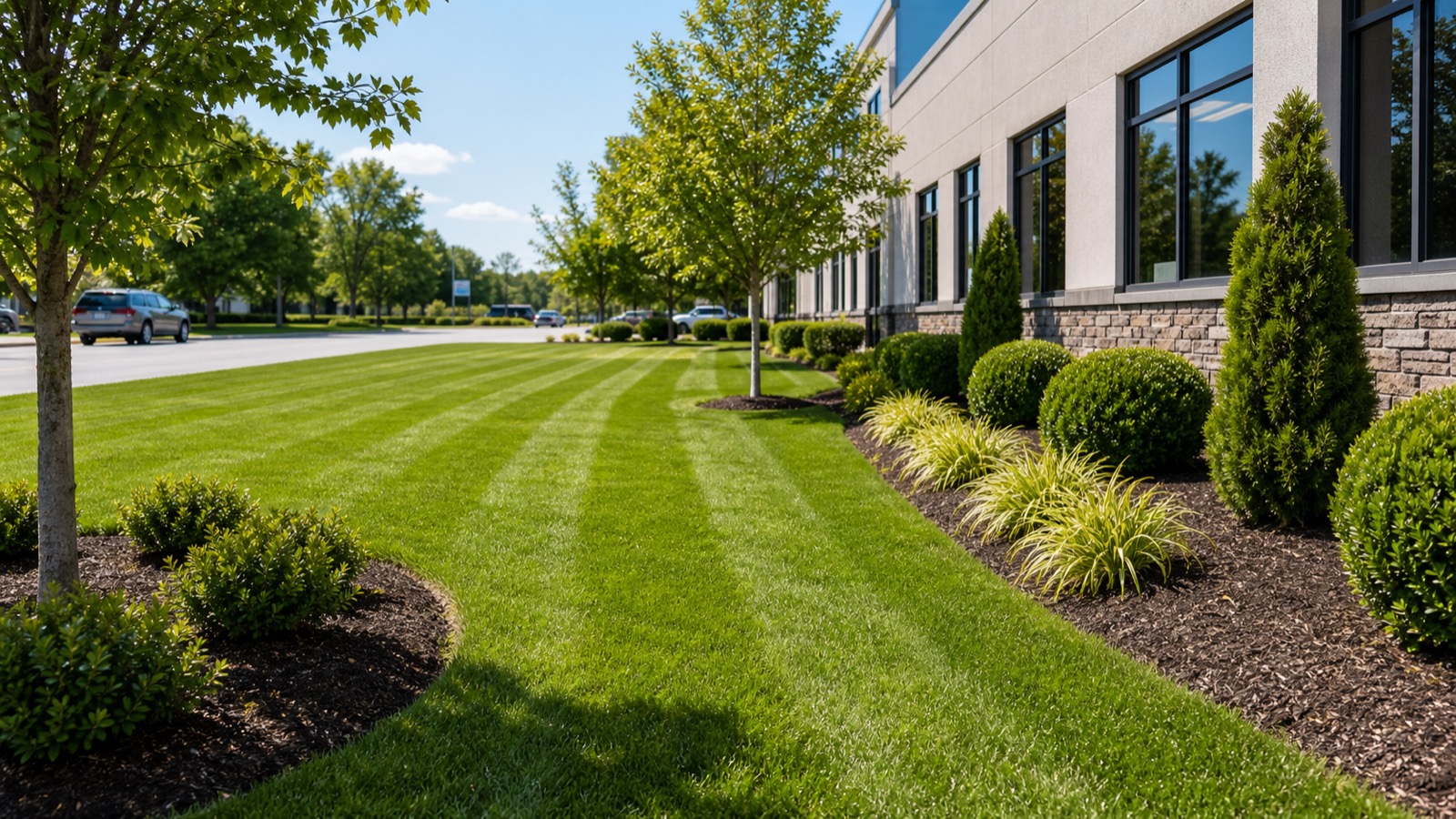
The lawn details people notice first are usually not hidden in the middle of a large grass area. They appear along entrances, sidewalks, curbs, signs, fence lines, parking edges, and building approaches. A commercial lawn plan should prioritize those visible boundaries while still defining the full mowing area.
Start with the view from the street and parking area
Walk the route a customer, tenant, employee, or visitor is likely to take. Look at the property entrance, monument or directional signs, parking-lot edges, front walks, and the approach to the main door. These areas often set the visual expectation before anyone sees the rest of the grounds.
That does not mean the back or side lawn should be ignored. It means the estimate can identify high-visibility areas where detail work matters most instead of treating every linear foot as equally noticeable.
Make mowing boundaries clear
A commercial property may include disconnected lawn sections, parking islands, drainage areas, shared boundaries, or narrow strips beside a road or building. Mark which areas belong to the customer and which should not be mowed.
Uneven access can affect how the finished property looks. Gate widths, bollards, parked vehicles, curbs, low branches, and soft ground may require a smaller mower or string trimming in places where larger equipment cannot operate.
Decide where trimming and edging matter
String trimming addresses grass around signs, fences, trees, utilities, buildings, and other obstacles a mower cannot reach. Edging defines selected boundaries where grass meets a sidewalk, curb, driveway, or bed. They are different tasks and should be listed separately in the quote.
A property may request trimming on routine visits while scheduling defined edging only when the agreed boundary needs it. Another property may want both included in the same scope. Frequency should follow the desired finish, actual growth, and budget rather than an automatic promise.
Include hard-surface cleanup in the finish
Mowing and trimming can leave clippings on walks, entrances, curbs, and parking edges. If blowing those surfaces is part of the quoted work, the final property view should be evaluated after that step—not while the service is still underway.
Loose gravel, litter, mulch, and small debris can be thrown by lawn equipment. The crew and property contact should identify sensitive areas, windows, vehicles, and entrances where extra care or a different approach may be needed.
Build the schedule around appearance and growth
Weekly mowing is common during faster growth, while bi-weekly or custom timing may fit other properties or parts of the season. The interval should consider actual growth, weather, lawn condition, property use, and the appearance the customer wants.
A schedule is a starting plan, not a guarantee that weather and growth will remain constant. Saturated ground, storms, drought, or unusual growth can change what is practical for a particular visit.
Keep the service scope focused
All Clean Solutions currently quotes mowing, string trimming, edging, blowing clippings from hard surfaces, and spring or fall leaf and debris cleanup. It does not currently offer fertilizer, weed treatment, aeration, overseeding, irrigation service, or mulch installation.
For a property-specific scope, review commercial and residential lawn care in Bismarck and Mandan and provide the address, lawn boundaries, photographs, access details, preferred frequency, and high-visibility areas.